
Refinance Calculator
Compare your current mortgage with a new loan. Calculate monthly payments, refinancing costs, interest savings, and your break-even point.
Current Loan
New Loan
Refinance Results
Monthly Payment Comparison
| Payment details | Current loan | New loan |
|---|---|---|
| Principal and interest | — | — |
| Property tax | — | — |
| Insurance | — | — |
| Mortgage insurance | $0.00 | — |
| Total monthly payment | — | — |
Total Loan Cost Comparison
| Details | Current loan | New loan |
|---|---|---|
| Loan term | — | — |
| Estimated remaining interest | — | — |
| Points and closing costs | — | — |
| Principal, interest and fees | — | — |
New Loan Amortization Schedule
Estimated annual principal, interest, and remaining balance.
| Year | Principal paid | Interest paid | Remaining balance |
|---|
How Does a Refinance Calculator Show Whether Refinancing Pays Off?
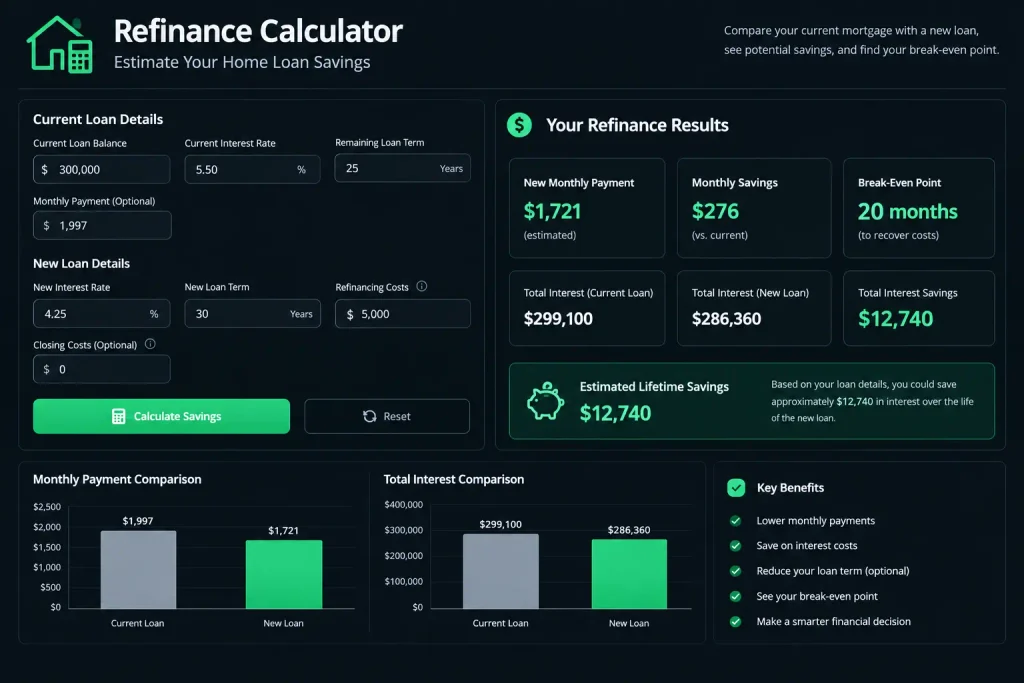
A refinance calculator compares your current mortgage with a proposed new loan and uses the balance, rate, years left, and costs you enter to estimate your new payment, monthly savings, and break-even point in months. If those savings repay the cost of refinancing before you sell, the refinance pays off; if they do not, it does not.
A sample output makes this concrete. One calculator shows $120 in monthly savings against refinance costs of $1,000, putting the break-even point at 9 months. Figures like these appear in seconds, which makes them a sensible first filter for any refinancing idea.
Treat every result as a gauge, never a promise. One bank’s calculator says outright that its dollar amounts are not guaranteed and are for illustrative and educational purposes only, because your home value, credit profile, and final lender quote will all move the answer. Accurate inputs give you a more useful estimate, which is why I rerun a calculator two or three times with slightly different assumptions before I trust a conclusion.
What Does It Actually Mean to Refinance a Mortgage?
Refinancing a mortgage means replacing your current mortgage with a new loan whose funds pay off the old one. Most borrowers do it to adjust the terms: a different rate, a different schedule, or a different loan structure. Lenders weigh your debt-to-income ratio alongside everything else, so underwriting feels much like the first time around.
The idea reaches well beyond houses. In the U.S., student debt follows a 10-year standard repayment plan by default, and swapping federal student loans into a new loan turns them private. That differs from student loan consolidation, a Department of Education program that merges federal debts into one, and borrowers with private student loans tend to see the clearest gains.
Timing decides whether any of this helps. I tell people not to refinance if they plan to sell before the break-even point, because the new loan’s fees will not have been repaid.
What Does a Refinance Calculator Actually Calculate?
A refinance calculator calculates the gap between what your current mortgage will cost and what a proposed replacement will cost, then shows the payment change and the months needed to recover your fees. It starts from the remaining loan amount, your current rate and the proposed new rate, plus fees that typically fall around 2% to 6% of the loan.
The break-even arithmetic is simple division. If refinancing costs $6,000 and you save $200 a month, you reach break-even in 30 months, and every month after that is a genuine gain.
Better tools go further. They compare the principal balance on both loans after the same number of payments, which exposes cases where a lower payment quietly hides a slower payoff. Some also use the appraised value of your property to judge equity, and others let you test future loans side by side. Always enter the repayment amount from your latest statement rather than a remembered figure.
How Long Until a Refinance Breaks Even?
A refinance breaks even when what you save each month has added up to the full cost of the new loan, and that point is measured in months. To see whether a deal is worth it, set your new monthly payment against the old one, then compare your savings over time with every fee you paid.
The test is blunt: the interest savings exceed fees, or the refinance loses money. How quickly you recoup that outlay depends on how long you keep the loan. If you plan to sell your home soon, or you are already more than half of the term into repayment, run the numbers before applying.
Quick break-even figures can flatter a deal. Variances between a sample quote and the final lender figures can eat into the margin, so lean on a proper cost-benefit analysis of the overall costs. A deal that avoids paying out-of-pocket at closing usually raises the loan balance instead, which pushes the break-even date further out.
Why Would Anyone Refinance a Mortgage?
People refinance a mortgage to reduce the rate or payment, change the loan structure, remove insurance costs, or raise cash. Rates and market conditions drive the classic case: if you borrowed in an expensive period and rates have fallen, a new loan can ease your wallet.
Credit matters too. A borrower who missed the best rate the first time and now has stronger credit may qualify for better terms, and sometimes it pays to wait to improve your credit before applying at all.
Structure is another trigger. An ARM, also called a variable-rate mortgage, holds an initial fixed interest rate period before it starts adjusting, and refinancing into a fixed loan before that window closes removes the uncertainty. Cancelling mortgage insurance is a further driver, since a large enough equity cushion can end the premium.
Debt consolidation completes the list. Folding card balances into a mortgage, or using a balance transfer card instead, delivers real financial benefits only when the new rate beats what you pay today.
How Much Does It Cost to Refinance a Mortgage?
The cost to refinance a mortgage is a share of the loan amount plus fixed fees such as appraisal and title work, so your final bill depends on location, loan type, loan size, and lender. Mortgage.com illustrates the idea with a $200,000 loan and costs of 3% of the loan; applying that rate to your own new loan amount gives a first-pass figure. Treat the result as an estimated budget, not a quote.
Points are the part many borrowers misread. One point equals 1% of the loan amount, so 2 points on a $100,000 mortgage equal $2,000. Those discount points buy a lower rate, while the annual cost of a loan, its APR, folds such fees into a single percentage.
Government-backed loans add their own lines. FHA borrowers face an upfront MIP of 1.75% of the FHA loan value, and upfront closing costs should be kept apart from escrow payments, which cover taxes and insurance and are not counted as closing costs.
You can avoid a cash bill by having fees rolled into the loan, but that raises the total amount borrowed. To compare honestly, apply with at least three lenders and request official Loan Estimates.
Which Type of Refinance Fits Your Situation?
The refinance type that fits depends on whether your goal is a better rate, a shorter term, cash, or lower insurance costs. A side-by-side comparison of loan types is the fastest way to choose. A plain rate-and-term swap keeps things simple and carries fewer restrictions than cash-out borrowing, though requirements vary by loan program and property type.
Borrowers who want to tap into home equity can take cash at closing. Some switch on Advanced settings in a calculator to turn it into a cash-out tool and enter the cash-out amount. The test is return on equity: the cash should earn or save more than the new borrowing costs.
A lump sum paid toward the balance does the reverse, raising equity and trimming payments. Insurance can shape the choice as well. FHA borrowers pay an FHA loan insurance premium, and moving to a conventional product after enough equity builds can remove it. Refinancing can also merge combo mortgages into one balance.
What Does Your Loan Term Change in a Refinance?
Your loan term sets how many years you have to repay the loan, and a refinance lets you choose a new one. Refinancing typically resets the clock to 15 or 30 years, so the length of your loan becomes a decision rather than a leftover. A shorter-term loan raises the payment but trims interest, while extending your loan term does the opposite. Enter the New loan term in your calculator and watch both numbers move.
Rate structure is the other half. A fixed-rate mortgage holds one rate for the entire term, whereas an adjustable-rate mortgage can change over the life of the loan.
Ending a fixed-rate loan early can trigger break costs from your current lender. Some loan agreements also include an early termination clause, so read the paperwork before you commit.
What Sits Inside a Monthly Mortgage Payment?
A monthly mortgage payment consists of principal and interest, plus property taxes, homeowners insurance, and, where required, PMI. Bank of America‘s calculator splits the result into Monthly Principal & Interest, Property Taxes, Homeowners Insurance, and PMI, then adds them into a Total monthly payment. Some tools show Principal and Interest Only, so compare like with like.
Where you live changes the tax line, which is why a ZIP code is an input. Interest, the charge for borrowing, is usually expressed as a percentage of the loan. Because mortgage payments are amortized, the total stays steady while the principal and interest split shifts every month.
PMI, provided by private insurers, protects the lender and generally applies when the down payment is less than 20%. A larger equity cushion can end it, and FHA borrowers can move to a conventional loan once enough equity builds to avoid MIP, which is one route to lowering monthly payments.
How Do Interest Rate, APR, Points and Payment Savings Differ?
Interest rate is the price of borrowing, APR adds fees to show the full yearly cost, points are a fee paid to lower the rate, and payment savings is the net monthly difference after everything is counted. Start by comparing rate options: shop refinance rates across lenders, then lock your refinance rate once you believe it is at its lowest. Reducing your interest rate by even a fraction can save thousands of dollars over the life of a loan.
Structure changes the risk. An ARM that becomes adjustable every six months after an initial 5, 7 or 10 years can bring rate increases when its index moves, and moving to a fixed loan beforehand removes that exposure.
APR comparisons also help with introductory offers. A card that accepts transferred balances may advertise 0% interest with an intro APR for a grace period such as 12 months, after which a usual rate returns.
How Does Refinancing Reset Your Amortization?
Refinancing resets amortization because the new loan begins a fresh schedule in which early payments are mostly interest. That is why calculators ask for your Origination year and Time remaining: they must compare your existing loan with the new schedule month by month. A new Fixed 30 Years schedule and a Fixed 15 Years schedule behave very differently over the number of months you hold them.
If you stretch your loan into a longer term, the payment drops but total interest over time rises. A bi-weekly plan is the alternative: bi-weekly payments equate to one extra payment each year and 51 fewer months on a 30-year loan.
Equity logic works in reverse for assets that lose value. A loan is upside-down when the balance exceeds the vehicle’s book value, which is a warning to check before refinancing anything longer.
Does Refinancing Student Loans Make Sense?
Refinancing student loans makes sense only when a new loan lowers your cost without costing you federal protections. Calculator.net lists cases where it may not fit, such as unpredictable income or a rate that is already low, because refinanced federal loans become private and lose federal benefits.
Paying for college costs with debt can leave borrowers in a financial rough patch, and relief options exist before refinancing: a switch from the standard plan to an income-based repayment option, a graduated option, or an extended one.
A refinance that selects a different repayment period can lower minimum repayment amounts, but borrowers with higher income may prefer a shorter one instead.
Is It Smart to Refinance a Car Loan?
Refinancing a car loan is smart only when the new loan lowers the total interest you will pay, because stretching a car loan usually raises that total. Loans backed by collateral, such as a car, can be moved onto a new loan, but the vehicle still secures the debt.
Extending the timeframe gives lower monthly repayments. Early in any amortizing loan, you pay more interest than principal, so a longer schedule keeps you in that stage for longer.
Some homeowners even draw cash from home equity for car repairs, but that shifts a short-lived expense onto a long mortgage, which I would weigh carefully.
Can You Refinance Credit Card Debt?
Credit card debt can be refinanced, most commonly by moving the balance onto a lower-rate card or a consolidation loan. Card debt behaves differently from an instalment loan, since the balance can keep growing.
Cards often carry high-interest debt after medical emergencies, and folding multiple debts into one payment can cut the cost of borrowing when the new rate is lower. Done under strain, the process can resemble debt restructuring, which renegotiates obligations to restore liquidity.
The first question I ask a borrower is whether the spending will stop, because a lower rate only helps when the balance stops growing. Borrowers with strong credit have a high chance of finding a consolidation loan with a low rate, and that is usually the cleaner route if a lender approves it.
When Does Refinancing a Personal Loan Help?
Refinancing a personal loan helps when the new loan has a lower rate or a better repayment period, and the interest saved outweighs the fees. In practice, some borrowers could refinance countless times, because there is no set limit other than lender approval.
Consolidation is the usual route. Debt consolidation loans roll revolving credit balances into one payment, and borrowers who consolidate high-interest-rate debt into a single lower-rate loan see long-term benefits only if the term does not balloon.
On the mortgage side, a Short refinance reduces what is owed to help avoid foreclosure, and borrowers in financial distress or with delinquent debts may need that route. Elsewhere, Grad PLUS loans and Parent PLUS loans usually carry higher rates, which is why they benefit most from refinancing.
How Often Can You Refinance?
A home loan can be refinanced repeatedly, since the main constraint is whether a lender approves each new application. Every application can bring a credit check and a credit assessment, and each switch can trigger costs: a discharge fee to close the old loan, a mortgage registration fee and other government charges, plus exit fees when you break a fixed term early.
Repetition has a hidden price. Every refinance restarts the amortization clock, and some lenders attach a prepayment penalty. For personal loans, a borrower can refinance as many times as they can get approved, though some lenders require paying down to 95% of the original balance first.
Student borrowers should weigh deferment, forbearance, or Teacher Student Loan Forgiveness before a refinance turns federal loans private. Removing an ex-spouse from a loan is another reason a repeat refinance can be justified.
What Credit Score Do You Need to Refinance?
Your credit score determines whether lenders approve a refinance and how low a rate they offer, with stronger scores earning better pricing. Zillow explains that a lower interest rate follows a higher score, so improving your score first can pay off.
Lenders also weigh credit histories, credit information, and financial stats. Published sample rates assume a borrower with excellent credit, so a real quote can be higher, and borrowers with good credit scores can often find lower-cost refinancing.
Programs differ. An FHA streamline refinance, backed by the Federal Housing Administration, requires a credit review and a mortgage in good standing.
For student debt, refinancing may be a poor fit with irregular income or a score below 650, and borrowers already on an income-based plan give up protection by leaving it.
How Much Equity Do You Need to Refinance?
You typically need about 20% equity to cancel mortgage insurance, although equity requirements for other refinance types vary by program. Equity builds through appreciation or by paying down principal, and borrowers who need cash for home improvements or a renovation will find cash-out lending stricter.
Insurers measure equity by LTV. PMI typically ends when LTV reaches 78%, meaning your down payment plus principal paid equals 22% of the purchase price, so insurance that exists to protect the lender can finally stop. In Australia, a loan with an LVR over 80% of the property value may require lender’s mortgage insurance.
| Refinance type | Equity expectation | Best suited to |
|---|---|---|
| VA streamline refinance | No full appraisal required | Eligible service members and surviving spouses seeking improved terms |
| USDA streamline refinance | Little to no equity needed | Borrowers with an existing USDA loan seeking lower payments |
| Reverse mortgage | Substantial equity needed | Homeowners over 62 who need more cash flow |
What Is a No-Closing-Cost Refinance?
A no-closing-cost refinance is a refinance in which closing costs are added to the loan instead of paid at closing. The loan balance and monthly payments both rise, so the deal may not save money unless you stay in your home long enough for the lower rate to repay the larger balance.
Closing costs, also known as settlement costs, typically run about 3-5% of the loan amount, and the refinance fees inside that figure vary by lender. Expect a minimum requirement of equity or credit that varies by program before any of these structures is offered.
The paperwork does not vanish. You still receive initial disclosures and review closing documents. On a car loan, similar fees appear as an administrative fee, lienholder fees, and state re-registration fees.
How Does the Refinancing Process Work Step by Step?
The refinancing process works in six steps: choose a refinance type, shop rates, apply, lock your rate, complete an appraisal, and close the loan.
- Choose a type. Pick a rate-and-term refinance, a cash-in refinance, or a cash-out refinance, whichever serves your financial goals.
- Shop rates. Compare offers from several lenders using a calculator.
- Apply. Your lender issues disclosures that outline the loan terms, including the Truth in Lending disclosure.
- Lock the rate. Do so when you believe it is lowest.
- Appraise. A property appraisal supports the property valuation, while the lender reviews your financial position.
- Close. Review the closing paperwork, pay applicable costs, and sign.
Think of the whole process as a redo of your mortgage. Fees along the way include application processing at $75 to $300, loan origination of 0.5% to 1.5%, an appraisal at $300 to $900, plus title search and attorney costs where required.
Remember that lenders have their own limits on how often and how far you can refinance, so confirm yours early.
What Information Do You Need Before Using a Refinance Calculator?
Before using a refinance calculator, you need your current loan balance, rate, and remaining term, plus a few details about the property’s value and your payment amount. NAB lists these inputs as the essentials for a useful result.
Lenders ask for supporting documentation when you actually apply: recent pay stubs, W-2s and bank statements, plus details of your existing mortgage.
Eligibility details change what you enter. A score of 620 or greater may be needed for approval, and Veterans holding VA loans may qualify for streamline terms.
Location matters as well. Property taxes are set by your county and other local bodies, and the local tax assessor can supply the rate. Use the repayments shown on your latest statement, not an old quote.
How Much Could a Refinance Calculator Show You Saving?
A refinance calculator can show how much lower your payment could be and how much interest you might avoid, though the figure is only as good as the inputs. Start with your current monthly payment, apply indicative interest rates, and read the result as an estimate only. A good use is to sense-check a lender’s pitch.
Borrowers with a score of 740 or higher tend to see the most favorable rates, which changes the monthly savings the tool reports. Costs then reduce the final figure, so subtract the fees below.
| Cost | Typical range | What it covers |
|---|---|---|
| Title insurance and related title work | $400 to $900 | Protection against errors in ownership records |
| Inspection | $175 to $300 | Needed only if the lender requires a home inspection |
| Recording fees | $25 to $250 | Official recording of the loan by local or state government |
| Survey | $250 to $600 | Verification of the property lines |
| Flood certification fee | $5 to $15 | Determining whether the home sits in a flood zone |
Property taxes also vary by place: they go to the school district and municipality where you live, so keep taxes consistent when comparing payments.
How do I calculate a refinance?
To calculate a refinance, compare your current mortgage payment and interest rate with the new loan. Include the new loan amount, interest rate, loan term, closing costs, and expected monthly savings. You can calculate the break-even point by dividing your total refinancing costs by your monthly savings. For example, if refinancing costs $6,000 and saves $300 per month, the break-even point is 20 months.
What is the 2% rule for refinancing?
The 2% rule suggests refinancing may be worthwhile when your new mortgage interest rate is at least 2 percentage points lower than your current rate. However, this is only a general guideline. Closing costs, loan term, monthly savings, and how long you plan to keep the mortgage should also be considered before refinancing.
How much does it cost to refinance a $300,000 loan?
Refinancing a $300,000 mortgage can typically cost around 2% to 6% of the loan amount, or approximately $6,000 to $18,000. Costs may include lender fees, appraisal, title services, credit checks, recording fees, and other closing costs. The exact amount depends on the lender, loan type, location, and whether you pay the costs upfront or add them to the new loan.
What is the best free refinance calculator?
The best free refinance calculator is one that compares your current mortgage with a new loan and shows monthly savings, closing costs, break-even time, and total interest savings. A calculator such as Zillow’s free refinance calculator can help you compare these numbers and determine whether refinancing may be worthwhile.