
TDEE, Diet and Health Calculator
Maintenance calories, goal targets, macros, daily limits, a sample meal plan, food calories and supplement and medicine information in one place.
What Does a TDEE Calculator Tell You?
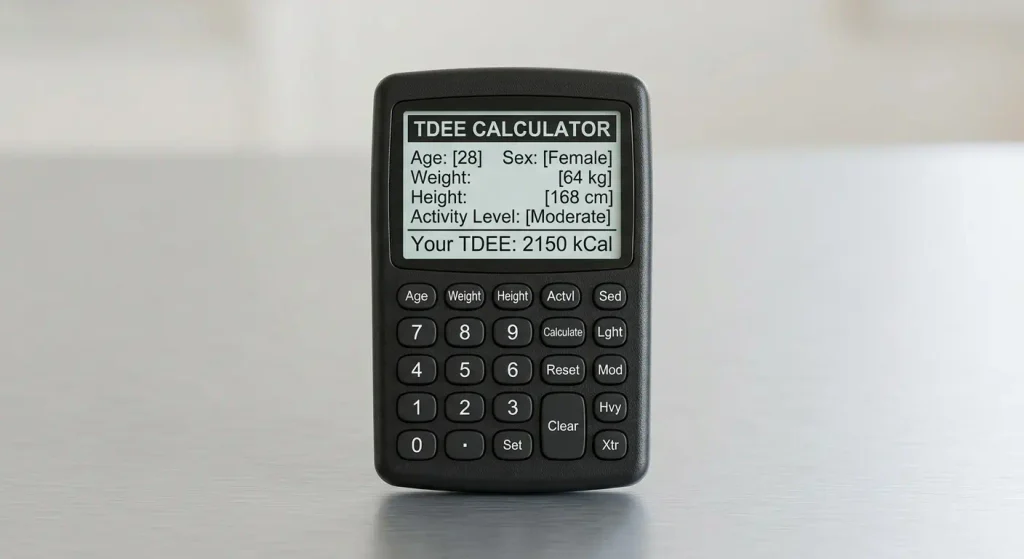
A TDEE calculator estimates how many calories you burn in a day by calculating your basal metabolic rate (usually with the Mifflin-St Jeor equation) and then adjusting it for your activity level. The result is the intake at which your weight stays the same, making it a starting point for any change you want to make.
The number is built from four components: resting burn, exercise, everyday movement, and digestion. Most online tools accept either Imperial or Metric units, so entering your details takes about a minute. The output is only as honest as the inputs, and even a well-built calculator lands within about 10% for most people, according to TDEE
Eat under the figure, and you create a calorie deficit; eat over it and weight climbs. Either way, experts treat the result as a draft to test against the scale rather than a verdict. That habit serves your health and wellness goals better than trusting any single printout.
What Does TDEE Actually Mean?
TDEE is the total number of calories your body burns across 24 hours, counting everything from resting to training. The biggest share goes to staying functional at complete rest, where the heart, brain, and organs keep working whether or not you move. Digestion takes a smaller slice, and daily activity covers the remainder.
The label itself is confusing. TDEE is the technical term, while the plain-language version is the amount you eat to stay level, and writers use the two interchangeably. Pick either one; the arithmetic underneath is identical.
No TDEE is universally good or bad. The figure is a reflection of body size and activity, and it says little on its own about lifelong health. Its practical value is showing what a safe and sustainable calorie gap looks like. Eating far under it for months makes training sessions harder, which is why TDEE warns against it.
How Does a TDEE Calculator Get Your Number?
A TDEE calculator gets your number by estimating basal metabolic rate from your inputs and then multiplying it by an activity factor that reflects how much you move. Everything else is detail about which formula supplies the first half.
Multiple formulas exist. Most tools lean on weight-based formulas that need only age, height, weight, and gender, while Built With Science asks for body fat to produce a more individualized estimate. Resting burn also drifts with age: the metabolic rate slows partly through natural muscle loss, though regular lifting largely offsets it.
Eating adds its own line item. The thermic effect of food is the energy spent digesting meals, and your body has to metabolize what you eat, which Built With Science puts at roughly 8–10% of total burn. Daily activity is the final piece: standing at a counter or walking between meetings counts, even on days with no workout.
Which Activity Level Should You Pick?
Pick the activity level that matches an ordinary week for you rather than your best week, because the activity multiplier is where most of the error in a TDEE estimate comes from. tdee.It says almost all of its error traces back to this one choice.
Exercise is only part of what counts. The Thermic Effect of Exercise covers deliberate training, yet household tasks, chores, pacing during a phone call, and carrying shopping up a flight of stairs burn calories as well. None of it happens in the gym hour, and all of it lifts the total.
Treat your pick as a hypothesis. Eat at the resulting figure for two or three weeks and weigh yourself a few mornings a week under the same conditions. If the average holds steady, the estimate was good. If it drifts the wrong way, consume fewer calories or add food, then give the change another fortnight. Don't obsess over a single reading, because one odd morning means nothing.
How Do You Use Your TDEE to Reach a Goal?
You use your TDEE by choosing a calorie target relative to it: eat at maintenance calories to hold your size, below it for cutting, above it for bulking. The distance from the figure sets the pace.
Eating at your TDEE lets you hold your current weight steady, because you are matching intake to expenditure. A cut of 500 calories a day gives roughly 0.5 kg (1 lb) a week, and a 250-calorie cut delivers half that, which tdee.is described as easier to stick with. Gaining works the same way in reverse, but a controlled surplus adds less unwanted fat than a bigger one. Fill the allowance with nutrient-dense foods and the numbers go further.
The calorie total sets direction; the split sets how the process feels. tdee.offers three presets:
| Preset | Split (protein/fat/carb) | Suited to |
| Moderate carb | 30% protein / 35% fat / 35% carb | The default for most people and most training |
| Lower carb | 40% / 40% / 20% | Fewer, heavier meals, or anyone watching blood sugar |
| Higher carb | 30% / 20% / 50% | Long sessions and high training volume |
Bigger gaps in either direction mostly buy a faster number on the scale and a worse experience, so a modest gap you can hold tends to beat a heroic one.
Is TDEE the Same as BMR?
No, TDEE is not the same as BMR: BMR counts only the calories burned at rest, while TDEE adds everything else you do in a day on top of it. Confusing the two is a classic mistake, and it quietly distorts every target built afterward.
BMR, also called resting energy expenditure, is measured under strict conditions. Forbes Health says the body needs a 12-hour fasting period and a neutral temperature so food and weather do not distort the reading. BMR is the largest portion of most people's TDEE, and Built With Science puts it at 60–70%.
An activity factor then scales up the BMR, and calorie goals should always use TDEE as their base. An active person who ate at BMR would land in a deficit far larger than intended. The multipliers below come from TDEE and the weekly patterns from tdeecalculator.net, so day ranges differ slightly between the two tools (tdee.is counts light exercise as 1–3 days a week):
| Activity level | Weekly pattern | Multiplier |
| Sedentary | office job | 1.2 |
| Light Exercise | 1-2 days/week | 1.375 |
| Moderate Exercise | 3-5 days/week | 1.55 |
| Heavy Exercise | 6-7 days/week | 1.725 |
| Athlete | 2x per day | 1.9 |
Multiply your BMR by the matching row, and the result is your TDEE.
Do Macros Matter Once You Know Your TDEE?
Yes, macronutrients matter, because the calorie total decides which way your weight moves, while the macro split decides how bearable the process is and how much of the loss is fat rather than muscle. Two plates can hit the same calories and look nothing alike.
A calorie target only tells you how much to eat. Feeding it into a macro calculator, or any similar calculator tool, converts the number into protein, fat, and carbohydrate. When progress stalls, I would check the split and the food logging before blaming the TDEE itself.
Some limits are firm. tdee.It says not to go under 1,200 calories a day without a doctor involved, and repeats the point about medical supervision for weight loss. Forbes Health adds that an overly large gap can hurt athletic performance.
Fluid needs move with workload too. If training changes, hydration needs change alongside calories, and a water intake calculator can set a daily target from body size, activity, and environment.
What Changes Your TDEE?
Your TDEE changes whenever your weight, muscle, activity, or eating history changes, so the figure from last year may no longer fit. Activity is the lever you control most directly.
NEAT, the energy burned in everyday motion from fidgeting to errands, varies so much between people that two matched profiles can diverge. Someone lightly active with a desk job burns far less than someone very active all week, and TDEE notes that people tend to overestimate their own activity. That individual variation explains why identical stats can sit a few hundred calories apart.
Muscle plays a part as well, since metabolically active tissue lifts resting burn and regular physical activity helps preserve it. Body weight itself matters, because the old target drifts as you shrink or grow: recalculate at every 5 to 10 kg (10 to 20 lbs) of change, whether you are on a mild cut or a mild bulk.
What Do Experts Say About TDEE?
Experts describe TDEE as a useful but incomplete estimate: it helps you avoid eating too little for your activity, but it covers only part of the health picture. An exercise-science professor quoted by Forbes Health adds that it is best not to fixate on the number.
The Forbes Health calculator was created under guidance from Forbes Health Advisory Board members. It uses Mifflin-St Jeor because the American Council on Exercise (ACE) considers it the most accurate way to estimate basal metabolic activity. The equation first appeared in 1990, published in the American Journal of Clinical Nutrition.
The practical warning concerns gaps. A large deficit can cost you performance and, as tdee.is noted, makes recovery and sleep suffer well before the scale shows anything. Built With Science adds a nuance: a beginner lifter may build muscle at or a little below TDEE in the early months, though a deliberate surplus becomes necessary to keep progressing afterward.
What Does TDEE Stand For?
TDEE stands for Total Daily Energy Expenditure, the number of calories your body burns in a day, and it incorporates resting burn, activity, and digestion. Eating at the figure keeps weight level, while eating slightly above your TDEE adds it slowly.
Sitting at the figure also works as a reset phase between a cut and a bulk. Built With Science notes that most adults fall between 1,600 and 3,000 calories per day, and the figure is adjusted downward as you lose weight.
How is TDEE Different From BMR?
TDEE differs from BMR because BMR counts only the calories burned at rest, whereas TDEE adds daily activity and digestion on top. TDEE usually lands 20% to 90% above BMR, while Built With Science puts active people 30–60% higher. BMR is what you would burn lying still in a dark room with a quiet digestive system. BMR formulas such as Mifflin-St Jeor estimate only that first piece.
How Many Calories Should You Eat to Lose Weight?
To lose weight, eat 250 to 500 calories below your TDEE, per TDEE.is; Built With Science suggests 300–500, which produces a loss of 0.3–0.7% of body weight per week. Leaner people should stay at the lower end of that range.
Keep protein near 1.6 g per kg, about 0.7 g per pound. Too big an energy deficit brings fatigue and illness, according to an expert quoted by Forbes Health. If the scale stalls, raising your daily step count widens the gap without cutting food.
How Accurate is a TDEE Calculator?
A TDEE calculator is an estimate, and Built With Science puts its margin of error at roughly 10–15%. Most of the error comes from the activity pick, so when unsure, take the lower factor. Track your weight for a few weeks, then move the target by 100 to 200 calories; two similar people can differ by hundreds of calories. Alexander Rothstein, Ed.D., an assistant professor of exercise science at the New York Institute of Technology, tells Forbes Health that TDEE gives only a small amount of the story.
How Often Should You Recalculate Your TDEE?
Recalculate your TDEE every 4–6 weeks, or whenever your weight shifts by 5–10 pounds. Check any estimate against two to four weeks of real weigh-ins before changing it. Dieting history matters too, since prolonged calorie restriction can bring metabolic adaptation and push the number lower. After recalculating, subtract or add your chosen gap for any calorie goal.
How is TDEE Calculated?
TDEE is calculated by estimating BMR and multiplying it by an activity factor. BMR is the energy you would burn if you did nothing but lie in bed, the minimum for keeping you alive. Mifflin-St Jeor is commonly used, whereas the Katch-McArdle approach works from lean body mass, which is total weight minus fat. The activity step covers everything beyond formal workout time. Skip the updates, and an old cut target quietly stops being a deficit.
How Do You Use TDEE to Build Muscle?
To build muscle, eat a modest amount above your TDEE: 200 to 350 calories, or 200–300 according to Built With Science. A bigger surplus mostly adds fat, so stay away from the higher end. Pair the surplus with resistance training or a team sport that actually loads the body. Protein and carbohydrate provide 4 calories per gram while fat provides 9 calories per gram, so the split matters. Treat the TDEE as a vital starting point, not a guarantee.
What is the Best TDEE Calculator?
There is no single best TDEE calculator; the formula behind it matters more than the brand. Forbes lists the revised Harris-Benedict formula and Katch-McArdle alongside Mifflin-St Jeor, and the Mifflin-St Jeor equation is the one Forbes Health and tdee.is use. Built With Science says body-fat-based versions can be more accurate for people with more or less muscle than average. tdee.is is free with no sign-up, so anyone can test it, and Forbes points readers to its Forbes Health Calorie Calculator for weight goals.
Is It Necessary to Calculate Your TDEE?
Calculating your TDEE is not mandatory, but it gives any nutrition plan a foundation. Knowing your baseline energy needs helps you avoid common nutrition mistakes, such as setting calories from BMR. Even someone whose only exercise is yoga benefits from a number to start from. Forbes Health quotes an exercise-science professor who calls measuring TDEE a motivational tool, as long as nobody turns it into a fixation.
What is a Good TDEE?
A good TDEE is simply one that matches your own body and activity; no ideal figure exists. Built With Science gives an example in which a regular exerciser with a modest BMR reaches 2,200–2,400 calories. A lighter body burns less, and hormones, including thyroid function, testosterone, and estrogen, also influence resting burn.
What is NEAT, and Why Does It Matter?
NEAT stands for Non-Exercise Activity Thermogenesis, the calories burned through everyday motion outside formal workouts. If you are on your feet all day, it can add a lot to your total. Raising your step count burns extra energy without extra gym time. Understanding your body this way lets you use the TDEE figure effectively.
How Does Body Composition Affect TDEE?
Body composition affects TDEE because muscle mass burns more at rest than fat tissue, so two people who weigh the same can have different totals. More muscle gives a higher resting metabolism, which is one reason lifting supports long-term fat loss: it keeps burn elevated between sessions. BMI, short for Body Mass Index, cannot see that split, so a body fat percentage input helps. As weight drops, BMR falls as well, and a body recomposition calculator can estimate calorie and macro targets for losing fat while keeping muscle.
How do I calculate my TDEE?
You can calculate your TDEE by entering your age, sex, height, weight, and activity level into a TDEE Calculator. The tool estimates your daily calorie needs based on your body details and activity habits.
How many calories should I eat based on my TDEE?
Your calorie intake depends on your goal. Eat around your TDEE to maintain your weight. Eat fewer calories than your TDEE to support weight loss, or eat more calories to support weight gain.
Is a TDEE Calculator accurate?
A TDEE Calculator provides an estimate, not an exact measurement. Your actual calorie needs may differ because of metabolism, daily movement, body composition, and other factors.
How does activity level affect TDEE?
Your activity level can change your total daily calorie needs. A person who exercises regularly or has an active job generally burns more calories than someone who spends most of the day sitting.
Can a TDEE Calculator help with weight loss?
Yes. A TDEE Calculator can help estimate the calories you burn daily. This information can help you plan a suitable calorie intake for weight loss while maintaining a balanced diet and healthy habits.
What information do I need to use a TDEE Calculator?
Most TDEE calculators ask for your age, sex, height, weight, and daily activity level. Some tools may also ask about your fitness goals or use different calculation methods to estimate your calorie needs.