
Free Online Salary Calculator: Fast and Easy
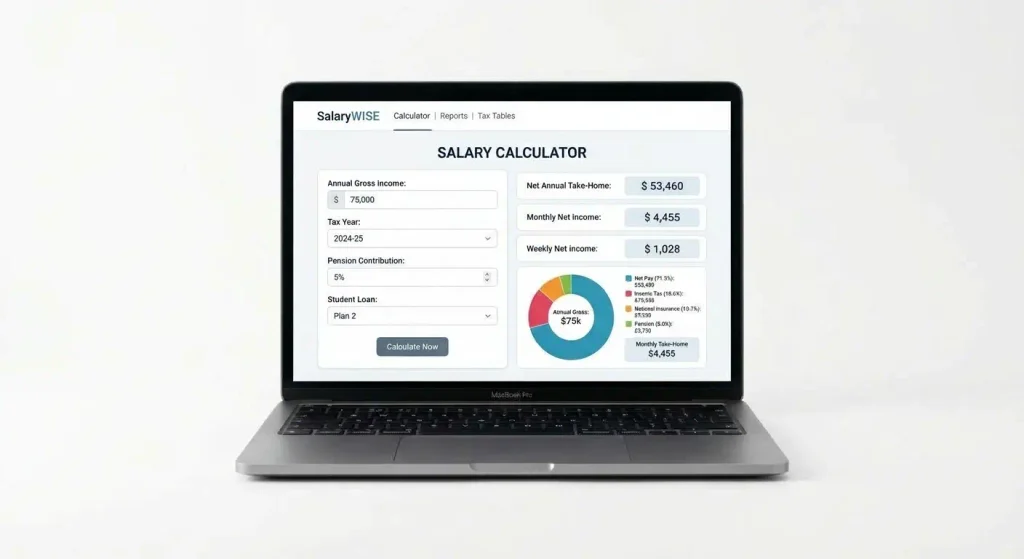
Salary & Earnings Calculator
Convert wages across frequencies and estimate net earnings after tax.
Use our free online salary calculator fast easy to convert salary amounts into different pay periods and compare your earnings quickly. The Salary Calculator converts salary amounts to their corresponding values based on payment frequency. Examples of payment frequencies include biweekly, semi-monthly, or monthly payments. Results include unadjusted figures and adjusted figures that account for vacation days and holidays per year.
This salary calculator assumes the hourly and daily salary inputs to be unadjusted values. All other pay frequency inputs are assumed to be holidays- and vacation-day-adjusted values. This calculator also assumes 52 working weeks or 260 weekdays per year in its calculations. The unadjusted results ignore the holidays and paid vacation days. The free online salary calculator fast easy can show both adjusted and unadjusted estimates when the relevant details are entered.
How a Free Online Salary Calculator Fast Easy Tool Helps
A free online salary calculator fast easy can help workers understand salary amounts across different payment schedules. It is useful when comparing an annual salary with hourly, weekly, or monthly pay.
A salary or wage is the payment from an employer to a worker for the time and work contributed. To protect workers, many countries enforce minimum wages set by either central or local governments. Also, unions may be formed in order to set standards in certain companies or industries.
A salary is normally paid on a regular basis, and the amount normally does not fluctuate based on the quality or quantity of work performed. An employee’s salary is commonly defined as an annual figure in an employment contract that is signed upon hiring. Salary can sometimes be accompanied by additional compensation such as goods or services.
Wage
Workers paid by the hour can also use a free online salary calculator to estimate their earnings based on hours worked and their hourly rate.
There are several technical differences between the terms “wage” and “salary.” For starters, while the word “salary” is best associated with employee compensation on an annual basis, the word “wage” is best associated with employee compensation based on the number of hours worked multiplied by an hourly rate of pay. Also, wage-earners tend to be non-exempt, which means they are subject to overtime wage regulations set by the government to protect workers.
In the U.S., these regulations are part of the Fair Labor Standards Act (FLSA). Non-exempt employees often receive 1.5 times their pay for any hours they work after surpassing 40 hours a week, also known as overtime pay, and sometimes double (and less commonly triple) their pay if they work on holidays.
Salaried employees generally do not receive such benefits; if they work over 40 hours a week or on a holiday, they will not be directly financially compensated for doing so. Generally speaking, wage-earners tend to earn less than salaried employees. For instance, a barista who works in a cafe may earn a “wage,” while a professional who works in an office setting may earn a “salary.” As a result, salaried positions often have a higher perceived status in society.
Most salaries and wages are paid periodically, typically monthly, semi-monthly, bi-weekly, weekly, etc. Although it is called a Salary Calculator, wage earners may still use it to convert amounts. A free online salary calculator is also useful for quickly and easily comparing hourly wages with salary-based pay.
Miscellaneous Employee Benefits
A free online salary calculator can help compare base pay, but employees should also consider benefits when reviewing a job offer.
While salary and wages are important, not all financial benefits from employment come in the form of a paycheck. Salaried employees, and to a lesser extent, wage-earners, typically have other benefits, such as employer-contributed healthcare insurance, payroll taxes (half of the Social Security and Medicare tax in the U.S.) that go towards old age and disability, unemployment tax, employer-contributed retirement plans, paid holiday/vacation days, bonuses, company discounts, and more. Part-time employees are less likely to have these benefits.
Miscellaneous employee benefits can be worth a significant amount in terms of monetary value. As such, it is important to consider these benefits as well as the base wage or salary offered when choosing between jobs.
Self-employed Contractors
Freelancers may use a free online salary calculator to compare hourly, daily, weekly, and annual income estimates before setting their rates. Self-employed contractors (freelancers who sell their goods and services as sole proprietorships) typically provide their own rates, which can be hourly, daily, or weekly, etc. Also, contractors generally do not have benefits such as paid time off, cheaper health insurance, or any other monetary perks typically associated with full-time employment.
As a result, their pay rates should generally be higher (sometimes significantly so) than the salaries of equivalent full-time positions. Nevertheless, rates in the real world are driven by many factors, and it is not rare to see contractors take lower compensation.
Self-employed contractors typically provide their own rates and manage their own work-life balance. To manage your daily energy needs and wellness schedule effectively while freelancing, check out our free TDEE Calculator to track your daily calorie expenditure.
How are Unadjusted and Adjusted Salaries calculated?
Calculate Pay with a Free Online Salary Calculator Fast Easy
A free online salary calculator makes it easier to compare adjusted and unadjusted salary estimates. Enter the hourly rate and working days to review an estimated annual amount.
Using a $30 hourly rate, an average of eight hours worked each day, and 260 working days a year (52 weeks multiplied by 5 working days a week), the annual unadjusted salary can be calculated as:
$30 × 8 × (260) = $62,400
As can be seen, the hourly rate is multiplied by the number of working days a year (unadjusted) and subsequently multiplied by the number of hours in a working day. The adjusted annual salary can be calculated as:
$30 × 8 × (260 – 25) = $56,400
Using 10 holidays and 15 paid vacation days a year, subtract these non-working days from the total number of working days a year. A free online salary calculator can help users review this adjusted estimate alongside the unadjusted figure.
All bi-weekly, semi-monthly, monthly, and quarterly figures are derived from these annual calculations. It is important to make the distinction between bi-weekly, which happens every two weeks, and semi-monthly, which occurs twice per month, usually on the fifteenth and final day of the month.
Different Pay Frequencies
With a free online salary calculator fast easy, users can compare common pay frequencies without calculating every amount manually. The calculator contains options to select from a number of periods normally used to express salary amounts, but actual pay frequencies as mandated by varying countries, states, industries, and companies can differ.
In the U.S., there is no federal law that mandates pay frequency, except one stating that employees must be paid in a routine and predictable manner. Mandatory consistent payments give employees a lot of stability and flexibility.
However, at the state level, most states have minimum pay frequency requirements except for Alabama, Florida, and South Carolina. For further details, consult state regulations regarding pay frequency.
The most common pay period frequencies tend to be monthly, semi-monthly (twice a month), bi-weekly (every two weeks), weekly, and daily. They are explained in the following chart.
- Daily | Pays every day, usually at the end of the day. Some short-term contractors are paid this way.
- Weekly | Pays once each week, usually on Fridays. Relatively costly for employers with 52 weeks a year, resulting in higher payroll processing costs, which is the main reason why it is less common than Bi-Weekly or Semi-Monthly.
- Bi-Weekly | Pays every two weeks, which comes out to 26 times a year for most years.
- Semi-Monthly | Pays twice each month, usually on the 15th and the last day of the month. Although common, it will result in inconsistent pay dates due to differences in dates from month to month.
- Monthly | Pays once per month. Usually the most cost-friendly option for employers. Not very common in the U.S.
A free online salary calculator can convert annual pay into a monthly estimate for easier comparison.
U.S. Salary Information
Use a free online salary calculator as a fast, easy starting point when reviewing salary offers, then check the applicable local wage and overtime rules. In the U.S., salaried employees are also often known as exempt employees, according to the Fair Labor Standards Act (FLSA). This means that they are exempt from minimum wage and overtime regulations, and certain rights and protections that are normally only granted to non-exempt employees.
To be considered exempt in the U.S., employees must make at least $684 per week (or $35,568 annually), receive a salary, and perform job responsibilities as defined by the FLSA. Certain jobs are specifically excluded from FLSA regulations, including many agricultural workers and truck drivers, but the majority of workers will be classified as either exempt or non-exempt.
The federal minimum wage rate is $7.25 an hour. However, states may have their own minimum wage rates that override the federal rate, as long as it is higher. For instance, the District of Columbia (DC) has the highest rate of all states at $17.95 and will use that figure for wage-earners in that jurisdiction instead of the federal rate. On the other hand, Georgia has their minimum wage rate set at $5.15, but the $7.25 federal minimum rate overrides it.
Factors that Influence Salary (and Wage) in the U.S. (Most Statistics are from the U.S. Bureau of Labor in 2025)
A free online salary calculator can help compare pay figures, but it cannot account for every factor that affects a person’s actual earnings.
In the third quarter of 2025, the average salary of a full-time employee in the U.S. is $1,214 per week, which comes out to $63,128 per year. While this is an average, keep in mind that it will vary according to many different factors. The following are only generalizations and are not true for everyone, especially with regard to race, ethnicity, and gender.
- Age: A person closer to their peak income years, which is 35-65, will generally have higher salaries. Men aged 35 to 44 had the highest annual earnings at $78,208, and women earned the most between the ages of 35 and 44 at $63,752.
- Education: The higher the attained level of education of a person, the higher their salary tends to be. Workers 25 or over without a high school degree had median earnings of $40,404 compared to $50,960 for high school graduates. Workers with at least bachelor’s degrees earned $90,844 annually on average.
- Experience: In general, the further entrenched a person is in their career, the more experience or perceived ability they have, or the more valuable their skill set, the higher their salary tends to be.
- Race and Ethnicity: Black men earned a median salary of $53,664, compared to white men at $70,824. The discrepancy is less for black women compared to white women: $48,204 and $57,356. Hispanic and Asian people of both genders earned $49,088 and $84,240, respectively.
- Gender: Men earned an average salary of $69,316, and women earned $55,952. Women are generally paid less than men, and this difference is called the gender pay gap. There are many reasons that this pay gap exists, including discrimination, the specific industry, motherhood, and gender roles.
- Industry: Industry affects wages paid, even in similar roles. For instance, all else being equal, an office clerk at a public school system will most likely make a lower salary than one at a private hedge fund. This also includes the relative stability of industries and companies and their forecasted trends.
- Location: Different locations will have different supplies and demands for positions, and average salaries in each area will reflect this. Keep in mind that the cost of living should be noted when comparing salaries. In some cases, a job that offers a higher salary may equate to less overall once the cost of living of a different location is accounted for.
- Misc.: To a lesser extent, salary is also influenced by the overall performance of companies; during years of high profits, a company may choose to pay a higher-than-average salary for a job applicant with excellent credentials. Also, in certain jobs, workers are expected to perform job responsibilities in dangerous working conditions, such as handling dangerous chemicals in a research facility, working in an underground mine with the presence of potential toxins, or patrolling a notoriously dangerous part of town as a police officer.
Such jobs can be compensated with a higher salary in the form of hazard pay. Similarly, people who work less favorable shift hours, such as the “graveyard shift,” which runs through the early hours of the morning, can sometimes earn a premium for doing so, due to the higher social and physical costs of working outside normal hours.
The 11 Annual Federal Holidays in the U.S.
When estimating annual pay, a free online salary calculator can be useful for considering how holidays may affect working days.
| January | New Year’s Day, Martin Luther King Jr. Day |
| February | Washington’s Birthday |
| May | Memorial Day |
| June | Juneteenth National Independence Day |
| July | Independence Day |
| September | Labor Day |
| October | Columbus Day |
| November | Veterans Day, Thanksgiving Day |
| December | Christmas Day |
Although there are 11 federal holidays in the U.S., companies typically allow time off for 6 to 11 holidays. Generally, only employees who work in a branch of the federal government benefit from all federal holidays. Employees who work for private employers are subject to the policy of their employer. Also, unless stated in a contract or collective bargaining agreement, an employer is not obligated to pay an employee anything extra, such as overtime for working on a federal holiday.
Other countries have a varying number of public holidays. Cambodia has the most days in a year in the world set aside to be non-working days, as established by law, at 28, followed by Sri Lanka at 25. Remember to adjust the “Holidays per Year” input to calculate a correct adjusted result. The free online salary calculator fast easy gives a more relevant estimate when the entered number of holidays matches the worker’s situation.
Vacation Days, or Paid Time Off (PTO)
To estimate pay with time off in mind, use a free online salary calculator fast and easy and enter the relevant holiday and vacation-day details where the calculator allows it. Traditionally in the U.S., vacation days were distinctly separate from holidays, sick leave, and personal days. Today, it is more common to have them all integrated together into a system called paid time off (PTO). PTO provides a pool of days that an employee can use for personal leave, sick leave, or vacation days. Most importantly, the reasons for taking time off do not have to be distinguished.
There’s no need to fumble over whether to designate an absence as sick or personal leave, or to have to ask the manager to use a vacation day as a sick day. There are, however, some downsides to having them combined. For instance, if an employee gets very sick for a week and has to take five days off, their total pool of PTO will be reduced by the five days absent, which may force them to reconsider the week-long vacation they had originally planned.
In the U.S., the Fair Labor Standards Act (FLSA) does not require employers to give their employees any vacation time off, paid or unpaid. Therefore, when interviewing and deciding between jobs, it may be wise to ask about the PTO policy of each potential employer. With that said, the average American gets around 10 days of PTO a year; the bottom 25% of wage earners only get an average of four paid vacation days a year. Most companies tend to institute a policy that increases the amount of PTO an employee gets every several years or so as an incentive to retain workers.
Most employers (over 75%) tend to provide vacation days or PTO for many beneficial reasons. They can help prevent employee burnout, maintain employee morale, or be used for any reasonable situations where leave is necessary. A free online salary calculator can estimate pay-period amounts, while the employer’s PTO policy explains which days are paid.
How Do I Calculate My Annual Salary From Hourly Pay?
To calculate your annual salary, multiply your hourly rate by the hours you work each day and the number of working days per year. For example, $20 per hour × 8 hours × 260 working days equals $41,600 per year before taxes.
How Can I Convert My Annual Salary to Monthly Pay?
Divide your annual salary by 12 to calculate your average monthly salary. For example, an annual salary of $60,000 equals $5,000 per month before taxes and deductions.
Is This a Free Online Salary Calculator Fast, Easy to Use?
Yes, a free online salary calculator fast easy tool helps you convert salary amounts between different pay periods. Enter your salary details, select the required pay frequency, and review the estimated results.
What Is the Difference Between Biweekly and Semi-Monthly Pay?
Biweekly pay means you receive a paycheck every two weeks, usually resulting in 26 paychecks per year. Semi-monthly pay means you receive two paychecks each month, resulting in 24 paychecks per year.
How Do Paid Holidays and Vacation Days Affect My Salary?
Paid holidays and vacation days usually do not reduce an employee’s agreed salary. However, they can affect calculations that estimate pay based on actual working days. The result depends on the calculator’s method and whether the time off is paid or unpaid.
Why Should I Use a Free Online Salary Calculator?
A free online salary calculator helps you compare job offers, convert pay frequencies, estimate annual income, and understand how working days affect earnings. It can also support budgeting and financial planning.